A Midwinter Window Watch for the Returning Light
A midwinter window watch helps you notice daylight returning: choose a view, keep a simple record and see seasonal change without special instruments.
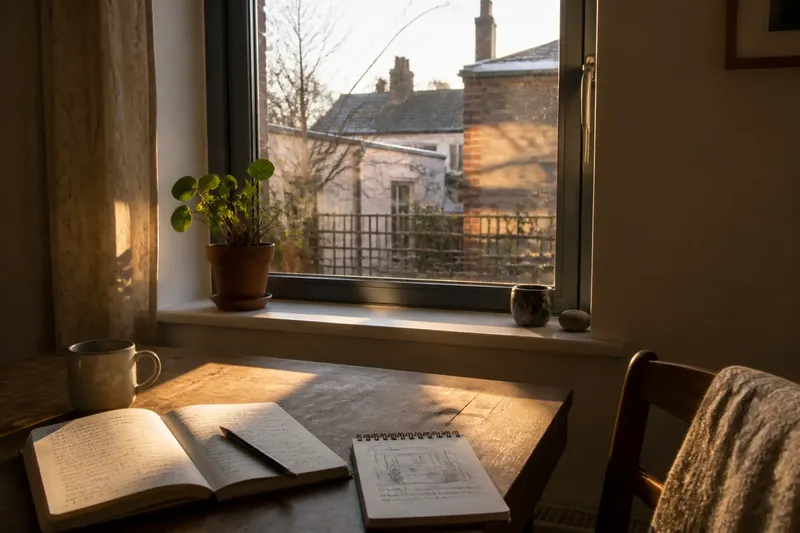
When does the afternoon light start reaching the far edge of your kitchen table again? A midwinter window watch lets you follow that gradual change from one familiar place, with a few written marks rather than a clock full of measurements. Choose a window you pass often, and let the view become a small appointment with the season.
1. Choose one window
Pick a window with a view that has a recognisable edge: a fence, a roofline, a tree trunk or the corner of a nearby building. That fixed feature gives your eye something steady to compare, even as clouds, branches and the angle of sunlight alter the scene.
Think about comfort as well as visibility. A window beside a breakfast chair may be easier to visit than one in a chilly spare room, and a view from indoors keeps the practice simple on wet or frosty days. You are watching what the light does there, not trying to find the sun itself.
Keep the viewpoint consistent. If you usually stand, choose a spot where you can put your feet in the same place; if you sit, use the same chair. A different angle can make a familiar patch of wall look newly bright, so returning to one position makes your notes more useful.
2. Set a viewing time
Choose a time that fits an existing routine, such as after breakfast or before you switch on the evening lamp. The exact hour matters less than returning at roughly the same point in your day. This lets you notice whether daylight reaches further into the room at that moment as the season turns.
Use an ordinary cue rather than an alarm if that feels more pleasant: putting the kettle on, clearing your lunch plate or closing a laptop can prompt a quick look. If life interrupts, skip the entry without trying to reconstruct it later. A record with occasional gaps can still tell a clear story.
It helps to make each visit brief. Look, write a line, then carry on. The point is not to watch continuously, but to catch the appearance of the room under a familiar set of conditions.
3. Pick a simple mark
Use a notebook, a calendar margin or a sheet of paper kept near the window. Write the date and a short description of where the daylight appears to fall. For instance: “bright strip reaches the chair leg” or “window side of the sill is lit”. A concrete detail is easier to compare than “brighter today”.
You can also draw a tiny outline of a fixed object and mark the bright area beside it. There is no need for a polished sketch; a box for the window, a line for the sill and a shaded patch are enough. If you prefer words, make a small set of phrases such as “glass only”, “sill”, “table edge” and “room beyond”, then add the phrase that fits.
Keep the record in one place. A pocket notebook works well if you move around the house, while a page taped inside a cupboard door keeps the pen close to the chosen window. Avoid turning this into a decorating project: a scrap of paper and an ordinary pencil will do.
4. Describe the light
Separate the light’s position from its character. Note where it lands, then add a word for how it looks: soft, sharp, pale, golden or broken by branches. This can help explain why two visits feel different even when the bright patch seems to occupy the same part of the room.
Notice shadows as well as illuminated surfaces. The edge of a shadow on a wall, the dark shape of a plant on the sill or the line cast by a chair can offer a clear visual marker. A shadow may shift with the sun’s position, while a cloud can briefly soften or erase it; recording both the mark and the conditions keeps the description honest.
Try to distinguish direct sunlight from general daylight. A room can look bright under a pale sky without a distinct beam crossing the floor. If you are unsure, write “diffuse light” or “cloudy” rather than forcing a precise description.
5. Note the conditions
A quick note about the sky can make later comparisons easier. “Clear”, “overcast” and “sun breaking through” are useful everyday descriptions. You might also mention a curtain left partly closed or a lamp switched on, since either can change what you notice from your usual spot.
Do not treat an overcast visit as a failed observation. Even when no sunbeam appears, you can notice whether the room seems light enough for reading, whether the window side looks paler than the opposite wall, or whether the view outside is easier to distinguish. Those small changes belong to the experience of daylight, too.
Say you choose a window facing a small courtyard and usually look just after breakfast. On one cloudy morning you write “sill grey, no clear shadow”; on another, a sunlit patch reaches the handle of a plant pot. The notes do not establish an exact boundary or explain every difference, but they give you two distinct observations to revisit.
6. Let the record breathe
Make the plan loose enough to keep. One or two entries in a week may suit a busy household better than a daily commitment. If you miss several visits, simply resume at the next convenient moment and note the gap only if it helps you remember the sequence.
Resist adding extra windows halfway through because one view seems more dramatic. The first window is your anchor. If you become curious about another room, you can start a separate page later, but mixing viewpoints in one record makes changes harder to interpret.
Likewise, avoid judging the season from a single striking afternoon. A low sun, a clear sky or a newly opened curtain can make the light feel dramatically different for reasons beyond the gradual return of longer daylight. A collection of modest observations gives the change room to emerge without demanding that every visit confirm it.
7. Read the page again
After several weeks, read your notes in order beside the window. Look for a change you can describe plainly: perhaps the bright patch reaches a familiar object more often, or the room keeps a visible glow later in your routine. If the entries are mixed, that is useful too; weather and household habits are part of what the window shows.
Compare like with like where you can. A clear morning is easier to set beside another clear morning than against a dim, rainy one. You need not sort the notes into a formal table; a pencil underline beneath recurring phrases may be enough to make a pattern visible.
A midwinter window watch is not a way to calculate the day’s length. It is a way to notice how seasonal light meets the particular shape of your room. The window’s direction, nearby buildings, trees and curtains all influence what reaches your chosen spot, so your record belongs to that view rather than standing in for every place.
What might you notice?
Does the light change every day?
Cloud, rain, mist and clear skies can make neighbouring visits look quite different. The seasonal shift is usually easier to recognise across a run of observations than in a comparison between two individual days.
Should you record the weather?
A brief sky description is helpful because it gives context to the light you saw. Keep it short, though: the window observation is the main event, not a full weather diary.
What if the window gets little sun?
You can still watch the brightness of the room, the outline of objects against the glass or the position of soft shadows. A view with indirect light can reveal seasonal changes more subtly than a sunbeam crossing the floor.
When should you stop?
Stop when the practice feels complete, whether that is after a few weeks or when the days no longer seem to change in the way you were watching. Keep the page if you like; it can remind you what the view looked like when you began.
For a midwinter window watch, the most useful note is often the one you can make without fuss: date, sky and one recognisable detail. Leave the notebook where you will see it, and let the returning light announce itself in its own small, observable ways.