Notebook or Loose Cards for Catching Passing Questions?
Notebook or loose cards for catching passing questions? Choose a format that makes it easier to return to a thought, connect it and follow it further.
You have just wondered why a familiar word sounds strange, or why a row of trees bends towards a path. Notebook or loose cards for catching passing questions? The useful answer depends on what you want to do when the question returns: follow its trail in order, or move it beside other thoughts.
A notebook keeps questions in a continuous sequence; loose cards let you gather and rearrange them. Neither format makes curiosity more reliable on its own. The choice is about how you revisit, connect and develop what you have noticed.
Choose your return path
Before choosing paper, imagine opening your record again after a busy week. If you would naturally flip back through a dated trail, a notebook may feel inviting. If you would rather spread questions across a table and sort them by resemblance, cards give you that freedom.
Think about the questions you tend to catch, too. A notebook suits thoughts that arrive as a chain: one answer prompts a second question, then a third. Cards suit questions that begin separately but might later prove to share a subject, place or puzzle.
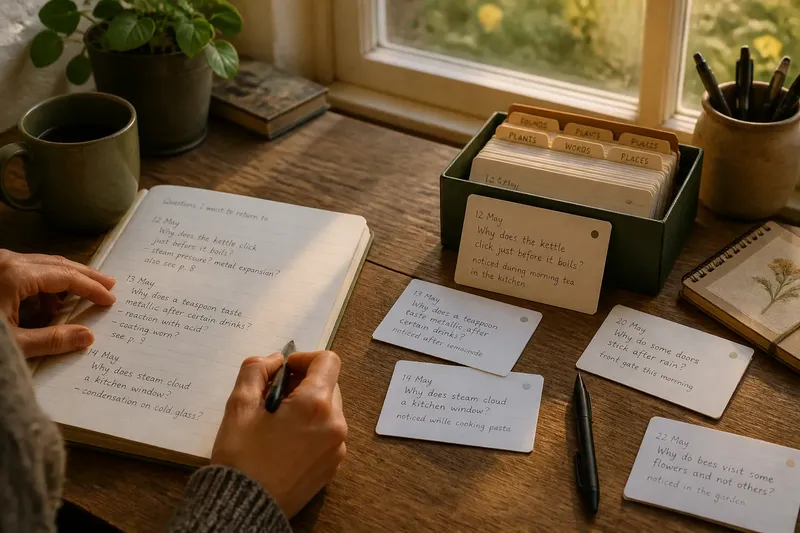
Say you are curious about why a kettle clicks, why a teaspoon tastes metallic after a certain drink, and why steam clouds a kitchen window. In a notebook, these can sit on successive pages, with observations added beneath each one as they occur. On cards, they can be gathered together under a temporary kitchen heading, while remaining easy to separate if the connection turns out to be unhelpful.
Set up a notebook
Choose a notebook small enough to keep near the places where questions occur, with pages that take the pen you like using. A plain, sewn notebook is easy to carry and browse; a ring-bound one can lie open on a desk. Leave elaborate indexing for later. The first job is simply to give each question a clear landing place.
- Give the first page a purpose. Write a simple label such as “Questions I want to return to”. Add a few blank lines for a contents list if you think you will use it.
- Date each entry. Write the date, then the question in a sentence. Dates help you recognise when and where a thought arose without turning the notebook into a diary.
- Keep the wording curious. “Why do some doors stick after rain?” is easier to revisit than “doors”. If you have a hunch, put it underneath as a possibility rather than quietly turning it into an answer.
- Leave room to follow the thread. Reserve a little space after the question, or continue later on a fresh page and add a page reference beside the original entry.
- Mark connections as they appear. Add a small arrow or note such as “also see p. 8” when another question feels related. You can decide what the relationship means when you return to both.
On the next pass, scan the most recent entries and mark the ones that still pull at you. Add a short note about what made you pause: perhaps the question came from a sound, a repeated pattern or a contradiction. That clue can be more useful than a polished answer because it helps you resume the thought.
Set up loose cards
For cards, use sturdy index cards or cut paper to a consistent size. Keep a pen and a small box, envelope or clip nearby, so capturing a thought does not require sorting it immediately. A card should be easy to read on its own, even when it is separated from the place where you first wrote it.
- Put one question on each card. Write a complete question, then add a brief clue about what prompted it. Keeping one main idea per card makes later rearrangement meaningful.
- Add a date or location. A note such as “noticed by the bus stop” can restore the scene and distinguish two questions that sound alike.
- Keep answers provisional. If you later learn something relevant, add a short note on the back or write a new card and link it to the first. Leave the original question visible.
- Make a few broad dividers. Use labels such as “sounds”, “plants” or “words” only when a group is large enough to need them. A card can move between groups as your understanding changes.
- Review the loose cards together. Spread them out and look for useful neighbours, not just matching labels. Put a small mark on cards that seem connected, then keep them together or note the link on each.
Cards reward handling: moving a question beside another can make a connection visible, while shifting it away can show that the similarity was superficial. To keep that freedom from becoming a rummage, return loose cards to a box or labelled envelope after each session. A card left in a coat pocket is still a record, but it is harder to find when the thought comes back.
Notebook or loose cards?
Use the form that matches your natural way of returning. A notebook is a good fit if you like chronology, continuous notes and the feeling of reading what came before. Cards are a good fit if you regularly compare, group and regroup questions, or want to carry a small selection to a particular place.
There is no need to make every question obey the same format. A notebook can hold a running record while a card carries one question you want to place beside others. If switching formats causes you to lose track, write a brief pointer in the notebook or on the card; the important thing is to know where a thought has gone.
Try a small trial before buying supplies or making a complex system. For a week, record questions in whichever format is already within reach, then look at what you actually did with them: did you add follow-up notes in sequence, or rearrange several questions into groups? Let that ordinary behaviour guide your choice.
Questions on the page?
Should I write down answers too?
Yes, if an answer helps you remember what you have already considered, but keep it visibly separate from the question. A note such as “possible explanation” leaves space for doubt and makes it easier to spot what you still want to find out.
What if I have no time to write?
Capture a few words in a phone note or on a scrap, then transfer them to your chosen format when convenient. Include a clue about the setting, since “odd sound” may not mean much once the moment has passed.
How do I stop old questions piling up?
During a regular browse, choose whether each question still interests you, has become clearer, or can be set aside. You do not need to solve every entry; crossing one out or marking it “not now” is a useful decision, not a failure.
Can I switch formats later?
Of course. Keep the original wording and date where practical, then move only the questions you want to revisit. A simple pointer to the new location is enough to preserve the trail.
Make returning easy
When you pick a format, give it a place you can reach without ceremony: a notebook by the reading chair, or cards in a tin near the kitchen table. At the end of a week, spend a few minutes with the entries and choose one question to carry forward. That small act turns a passing thought into something you can meet again.
For notebook or loose cards, the best test is not how tidy the pages look but how readily a question leads you back to noticing. Keep the record light enough to use, and let its shape change when the way you connect ideas changes too.