Why Wet Pavement Can Look Brighter Than Dry Stone
Why wet pavement looks brighter than dry stone depends on the light above and your viewing angle. Learn to read the moving sheen on a rainy walk.
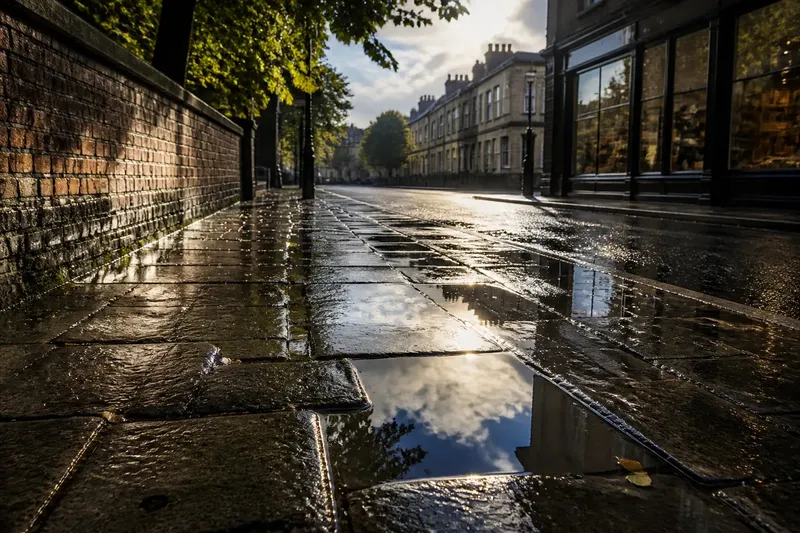
Why does wet pavement look brighter than dry stone in one spot, then turn dark a few steps away? After rain, a path may flash with the pale sky while a nearby stretch stays dull. The change comes from how a thin film of water redirects light, not from the stone suddenly changing colour.
Watch the same patch as you move along the pavement. A gleam may shift towards a puddle, vanish beneath a tree or appear as a streak beside a shop window. The surface, its surroundings and your viewpoint all help determine what reaches your eyes.
Light and angle
Dry stone has tiny grains and ridges pointing in many directions. They scatter incoming light broadly, so a matte surface sends some light towards you and some elsewhere.
Water fills small hollows and creates smoother patches over the stone. Light can reflect from the water’s surface before reaching the mineral grains. If that reflection points towards your eyes, the pavement may look glossy or mirror-like.
- Looking down: If a bright patch of sky reflects towards you, expect a pale sheen; if it does not, look from a slightly different position.
- Facing a low sun: If a wet patch catches the sunlight at an angle that sends a glint towards you, expect a sharp shine; if not, compare a nearby patch facing another way.
- Looking across the ground: If ridges and dips catch light differently, expect bands of brightness and shade; if the surface looks even, move sideways to reveal changes in the reflection.
- Standing beneath trees: If leaves and shadow dominate the reflection, expect a darker or dappled path; if a bright opening in the canopy is visible, check whether it appears as a lighter patch on the ground.
These observations help distinguish reflection from the stone’s own scattered light. A highlight that appears or disappears as you shift your viewpoint is a clue that reflected surroundings are contributing to the sheen.
Water and texture
A thin film can smooth parts of the surface without hiding the stone’s texture. Damp paving may look softly glossy while still showing its grain.
A puddle offers a broader, smoother water surface, so it can reflect a recognisable patch of cloud or a window. Ripples distort that image, while rough paving breaks reflections into smaller glints around grains and shallow hollows.
Dry stone scatters light too, and its appearance depends on its colour and finish. Wetness changes how light moves across the surface; it does not erase differences between pale, finely cut stone and dark, porous paving.
What does the sheen tell you?
Why does wet pavement sometimes look darker?
It may reflect a dark tree canopy, a shaded building or dim ground rather than a bright sky. The wet surface can also make the stone’s colour look richer by reducing the pale scattered light that would otherwise reach your eyes.
Why does the shine move when I move?
As you walk, the angle between the light source, the surface and your eyes changes. A reflection directed towards you can then travel elsewhere, making the bright patch seem to slide or disappear.
Why do puddles reflect more clearly than damp stone?
A puddle has a broader, smoother surface than a thin film on rough paving. Grains, ridges and hollows interrupt the reflection on the pavement, so its image is more likely to look broken up.
Can wet stone change colour?
The mineral material does not change colour simply because it is wet, but it can look darker, richer or more saturated. Water alters how light enters and leaves the surface, while reflections add colours from the surroundings.
A pavement comparison
Say you are walking beside a brick wall after a shower. The dark-grey path is rough, with water caught in shallow grooves, and a pale shop window stands across the street. Looking straight down, you notice scattered light in the grooves; turning towards the window brings a brighter streak across the wet patches. The visible result is a reflection that shifts with your viewpoint, not a sudden change in the stone.
You can read a real patch in the same way: compare a puddle with a thin film, look down and then from the side, and notice which parts of the sky or nearby buildings appear on the ground. If the view remains unclear, check whether the surface is rough, rippled or shaded before deciding that the stone itself looks lighter.
Reading wet pavement
A phone photograph can help you remember where a highlight appeared, but it is not a precise record of brightness. Automatic exposure may darken the image around a gleam or brighten shaded paving, and the screen can display colours differently from the scene.
Why wet pavement looks brighter than dry stone becomes easier to understand when you look for the source of the sheen. A small smooth patch can sparkle under a bright sky, while a rough stretch beneath a dark canopy stays subdued; the useful clue is how the reflection changes as you move.