The Comma’s Long Journey from Breath Mark to Punctuation
The comma’s history explains how it can suggest a pause and clarify sentence structure, helping you choose punctuation by grammar and meaning, not breath alone.
Why does a comma sometimes seem to ask you to pause, yet belong in a sentence where nobody would naturally take a breath? The comma’s history offers a useful clue: punctuation has served both the spoken voice and the reader’s need to see how a sentence is put together.
Those two jobs still coexist. Reading aloud can help you hear a sentence’s shape, but a comma on the page must also clarify relationships between words and clauses. The right choice depends on which job the mark is doing.
Voice and breath
Early writing did not always use the spacing and punctuation familiar to readers today. Practices varied across texts and periods, and some marks helped guide reading aloud by indicating a pause or a point of phrasing. It is safer to think of the comma’s ancestry as part of this varied reading tradition than as a single, settled system.
That connection with the voice still makes intuitive sense. When a sentence turns or introduces a list, a pause can help a listener follow it. But speech is flexible: one reader may pause where another continues, and breathing alone does not reliably identify a sentence’s grammatical boundaries.
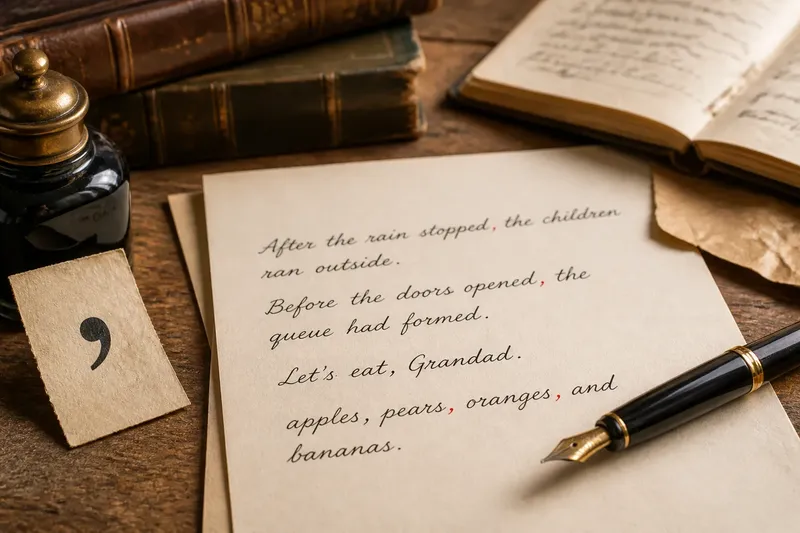
Imagine someone reading, “After the rain stopped, the children ran outside.” They might pause after “stopped” because the opening clause sets the scene. The comma also marks the boundary between that clause and the main statement, even if the sentence is read without a noticeable pause.
Structure on the page
Over time, punctuation conventions took shape in different ways across written English. Commas came to serve as visual guides as well as cues for phrasing; their use depends on the relevant convention and the sentence’s structure, not simply on where a speaker takes a breath.
A comma can mark the end of an introductory clause, set off some extra information, or separate items in a series. In each case, ask what the words are doing before deciding whether a comma belongs.
Consider “Let’s eat, Grandad” and “Let’s eat Grandad”. The comma in the first sentence marks direct address: Grandad is being spoken to, not named as the meal. The contrast shows how a small mark can make a relationship between words visible.
Questions about commas?
Should I place commas where I breathe?
Use breath as a clue, not a rule. A pause may point to a boundary worth checking, but it may also reflect emphasis or speaking style rather than sentence structure.
Do commas always mean a pause?
No. Some commas clarify a sentence without calling for a noticeable break in speech, while a speaker may pause without needing a comma. Read aloud if it helps, then check the grammatical relationship.
Why do comma choices vary?
Some comma choices are matters of style, especially in lists or around information that could be set apart in different ways. Follow the relevant house style where one applies, while keeping the sentence’s meaning clear.
How can I tell whether a comma belongs?
Ask what the mark separates or sets apart. If you cannot name its function, check whether removing it makes the sentence confusing or changes its meaning; a pause by itself is not enough.
Three comma approaches
These three checks work best in a clear order: use sound to spot a possible problem, grammar to identify the sentence’s parts, and meaning to judge the final wording.
- Listen for phrasing: Read the sentence aloud and note where a pause seems helpful. If that pause coincides with a clause or phrase boundary, check whether a comma is appropriate there; if it does not, keep the words together and revise the phrasing instead.
- Identify the structure: Mark the clauses, introductory material, direct address or list items. If the comma separates or sets apart a recognised part, use the punctuation convention that fits; if it divides closely connected words without a clear function, remove it or recast the sentence.
- Check the meaning: Ask what a reader might misunderstand and whether the comma changes that reading. If it makes the intended relationship clearer, keep it; if it introduces ambiguity or serves no clear purpose, rewrite the sentence or leave the comma out.
- Check the style: Look at the punctuation guidance for the document, particularly for optional commas in lists or around extra information. If the guidance specifies a choice, apply it consistently; if there is no house style, choose the version that reads most clearly and use it consistently.
- Read the result again: Check the sentence with the comma in place, then without it. If one version is easier to parse and preserves the intended meaning, choose that version; if neither is clear, change the wording rather than adding punctuation at random.
- Check for direct address: Identify whether a name refers to someone being spoken to. If it does, set it off with the appropriate comma; if the name is part of the sentence rather than an address, do not separate it as though the reader were being spoken to.
These approaches are not rival punctuation systems. Sound can draw attention to a snag, structure can explain a comma’s job, and meaning can show whether the final sentence is clear.
Choosing a comma
Say you are revising this sentence: “Before the doors opened the queue had formed.” The starting wording has an introductory clause, “Before the doors opened”, followed by the main clause, “the queue had formed”. First, read it aloud; a pause after “opened” may sound natural. Next, identify the clause boundary and place a comma after “opened”. Finally, read the revised sentence—“Before the doors opened, the queue had formed.”—to check that the opening and main clauses are easy to distinguish. The comma is justified by the structure, while the pause is a helpful cue.
With a list, first identify each item and check whether any item already contains a comma. If the boundaries are hard to see, choose punctuation consistent with the document’s style; if the list remains confusing, rewrite it so each item is easier to distinguish. Reading the list aloud can help, but visual structure often does more of the work.
Sound and syntax
The comma’s history is not a simple switch from sound to grammar. Reading aloud still draws attention to rhythm, while punctuation conventions help readers understand how a sentence is assembled. Which role matters most changes with the task: a performance invites attention to phrasing, while an edit asks what each clause or phrase is doing.
When deciding where a comma belongs, start with the relationship between the words, then listen to how the sentence reads. That balance is the most useful way to understand the comma’s journey from a reading aid to a mark that also helps the eye follow a sentence.
For a quick comma check, remember the phrase rather than the breath: identify the structure, then confirm the meaning. A natural pause can guide your attention, but the sentence itself should decide the punctuation.